 Matcha
Matcha gasless swaps include gas costs in eligible Auto quotes
Last updated:
Matcha gasless swaps let eligible Matcha Auto trades settle with network costs included in the token quote. A relayer pays native gas upfront and recovers the cost through the trade. On Ethereum Virtual Machine (EVM) networks, trading without a native-token balance requires sufficient spending permission or a supported gasless approval.
Token approval authorizes spending, gas reimbursement repays the submitter, and a swap fee charges for the trading service. These components can appear together in a quote even though their conditions differ. The approval requirement matters especially when a wallet holds tokens without native gas.
An EVM wallet can swap without native gas only when the selected Auto trade has sufficient spending permission or supported gasless approval.
Auto quotes and confirmed settlement
An eligible Auto quote connects the selected tokens, trade amount, and wallet to an exchange that Matcha can submit. Sufficient sell-token funds are a prerequisite. The EVM flow also needs usable spending permission. Where permission needs updating, the approval method determines whether that update can happen gaslessly. The wallet owner reviews the exchange terms before signing the trade authorization. Matcha then submits the authorized swap through its relaying infrastructure, which handles the network payment.
A signature authorizes execution; completion requires successful settlement on the selected blockchain. A submission response or trade identifier does not establish that the recipient received tokens. The settled transaction and actual recipient amount distinguish a completed exchange from an accepted request.
Relayers and token-denominated gas
Relayed execution separates the wallet that authorizes token spending from the account that submits and funds the blockchain transaction. Matcha Auto uses 0x's Gasless API for relayed swaps on supported EVM networks. A meta-transaction carries the user's signed authorization so another party can execute the permitted action. The relayer pays the blockchain in its native gas token, while the trade compensates that expense using whichever traded token the quote designates, which can be the sell token or the buy token.
Gas reimbursement and swap fees
Matcha Auto's network charge and swap fee pay for different parts of execution, even when both appear within the trade. Network reimbursement covers blockchain transaction costs. The same-chain Auto fee schedule lists a 0.25% swap fee for most pairs and no swap fee for stablecoin-to-stablecoin trades. The selected quote supplies the applicable charge. A waived swap fee leaves the network-cost component in place.
A charge taken from the buy token reduces the receipt, while a sell-token charge consumes part of the starting balance. Compare net output for the same sell amount, and include any separately required approval gas when comparing a Standard quote.
Token buy and sell taxes are separate contract-level deductions. Gasless execution changes how network costs are funded; it does not remove a token's transfer rules.
Approval support before a gasless swap
On EVM networks, gasless approval depends on the sell token's authorization method and the wallet's existing allowance for the required spender. EIP-2612 permits allow compatible tokens to accept signed spending permission. Related permit methods also exist, including ERC-7597 support in the 0x Gasless API. A supported permit can accompany the signed trade in relayed execution. A token without supported gasless approval requires a standard approval transaction with gas paid in the network's native token when its existing allowance is insufficient.
Permit2 needs permission from the token contract before it can move that token, so its later signature-based transfers do not erase an initial approval requirement that the wallet has not yet satisfied. Gasless API distinguishes insufficient allowance from available gasless approval, so those conditions should be assessed separately. The approval must name the required spender and the intended token. In the EVM Gasless API's standard approval flow, AllowanceHolder or Permit2 is the allowance target identified by the quote; the Settler contract must not receive a token allowance.
Network, token, and trade-size eligibility
Gasless availability depends on an executable quote for the selected network, sell token, buy token, and amount. The EVM Gasless API supports selling non-native tokens, subject to trade eligibility and liquidity. Selling a chain's native coin requires another supported execution path, such as Standard mode; wrapping it beforehand is a separate operation with its own requirements. Auto can also become unavailable when network fees exceed the trade's value. This creates a changing trade-size boundary because transaction costs vary. Solana trades have different network costs, including priority fees and token-account rent where applicable; EVM permit rules do not describe those transactions.
Failed execution and relayer resubmission
Matcha Auto simulates proposed transactions before submission to catch problems that would prevent execution. Simulation can reject a bad trade before a blockchain transaction occurs. Network conditions can change afterward, including gas prices. Matcha Auto covers the gas cost of its relayer's transaction resubmissions. That coverage addresses an execution expense; it supplies neither missing tokens nor missing spending permission. Completion still requires an executable exchange under the authorized terms.
A pending trade needs its existing status checked before another authorization. A refreshed quote does not establish what happened to an earlier submitted trade.
Auto, Standard, and other order types
Matcha Standard makes the wallet pay network gas separately, while an eligible Auto quote incorporates the network cost. Their swap-fee treatment also needs comparing for the selected pair; disabling Auto does not establish that a trade has no swap fee. Cross-chain swaps have their own fees and network requirements because they move value between networks. Matcha limit orders have a different purpose: they offer signed exchange terms for a potential later fill. The lack of an upfront creation transaction does not make their filling conditions equivalent to an Auto market swap.
A net-output condition without native gas
In this hypothetical same-chain EVM Auto trade, the wallet has no native gas token, sufficient sell-token funds, and an adequate existing allowance. Its owner accepts only a quoted minimum receipt of at least 137 units of the chosen buy token.
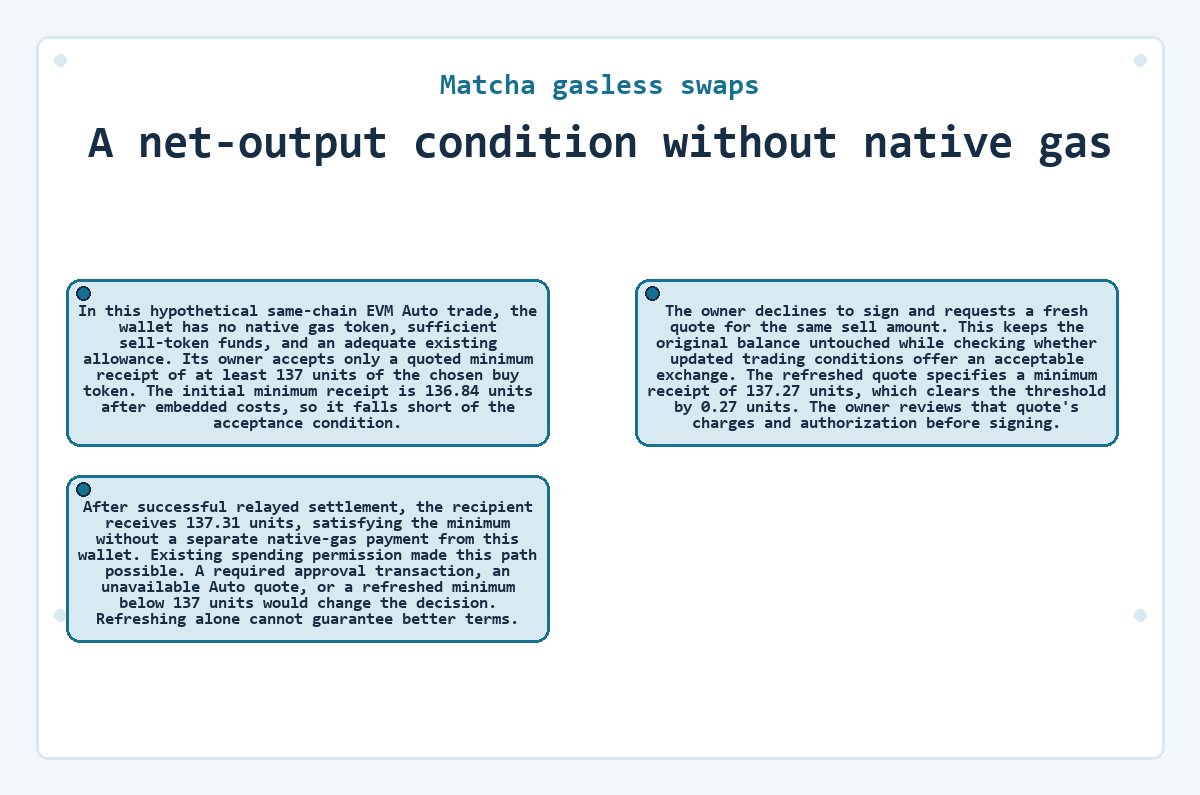
The initial minimum receipt is 136.84 units after embedded costs, so it falls short of the acceptance condition. The owner declines to sign and requests a fresh quote for the same sell amount. This keeps the original balance untouched while checking whether updated trading conditions offer an acceptable exchange. The refreshed quote specifies a minimum receipt of 137.27 units, which clears the threshold by 0.27 units. The owner reviews that quote's charges and authorization before signing.
After successful relayed settlement, the recipient receives 137.31 units, satisfying the minimum without a separate native-gas payment from this wallet. Existing spending permission made this path possible. A required approval transaction, an unavailable Auto quote, or a refreshed minimum below 137 units would change the decision. Refreshing alone cannot guarantee better terms.
Useful questions about Matcha gasless swaps
Why can Auto show an insufficient balance when I enter the amount to receive?
An Auto quote based on an entered receive amount can require sell tokens for both the purchase and the network charge. Specifying the desired receive amount may put gas reimbursement on the sell-token side. A balance that covers the exchange alone can therefore be insufficient. Compare the total required sell amount with the available balance. Entering a sell amount within that balance lets Auto quote the receive amount with gas reimbursement deducted from the buy token.
Does a gasless Auto swap hide my wallet address?
Gasless execution does not hide the addresses and token movements recorded by a public blockchain. A relayer submits the transaction, and private submission can reduce exposure before inclusion, but successful settlement still creates an on-chain record. The signed trade also has to reach the service that executes it, so a wallet signature does not make its contents private to the signer.
Can an Auto swap deliver a native token that I can later spend on gas?
An eligible Matcha Auto swap can buy a native token even though the EVM gasless path does not support selling a native coin directly. Receiving the selected network's native token can provide a balance for later transactions on that network. The purchase still needs sufficient sell-token funds and valid spending permission. A native balance on another blockchain does not pay the selected network's transaction fees.
What happens to an existing token allowance after an Auto swap fails?
A previously confirmed token allowance can remain active after a later Auto swap fails. The approval and the failed exchange have separate execution histories. Failure alone does not revoke spending permission, and the remaining allowance depends on the token contract's state. Permit2's initial token allowance is also distinct from an individual signed transfer authorization. Review the affected token's actual permission rather than treating a failed-trade status as an approval cancellation.
Do I need a smart contract wallet to sign a gasless Auto trade?
A compatible ordinary wallet can sign a gasless Auto trade without being a smart contract wallet. On the EVM path, the wallet must support the typed-message signing required by the returned trade authorization. Signature-based gasless approvals also depend on the token's permit implementation and wallet compatibility. A wallet's connection method does not establish those capabilities, and choosing a smart contract wallet alone does not remove an unsupported token's approval requirement.